
VR for Kids: Age Limits, Safety Tips, and What Parents Should Know
Virtual reality and kids are a combination that comes with legitimate questions. What age is actually appropriate? Is it safe? Will my child be able to figure it out? What if they hate it, or what if they never want to leave?
These are the questions we hear most often from parents before their first visit to HEROES VR Adventures, and they're worth answering. The answers shouldn’t be a reassurance that glosses over real concerns, but with the kind that's actually grounded in what the research says and what we see every day at the venue.
Putting It in Perspective
A trip to HEROES is a special outing, not a daily screen habit. That context matters when thinking about VR and kids.
Think about it this way: parents don't pull their kids out of a movie every 15 minutes to rest their eyes. A movie is a bounded, occasional experience, different in kind from two hours of YouTube scrolling at home.
A visit to HEROES sits in the same category: a contained, supervised, active experience that's fundamentally different from the kind of passive daily screen time that health guidelines are primarily concerned about.
One concern with traditional screen time is that kids often sit still for long periods. VR changes that premise. VR at HEROES involves real physical movement like ducking, reaching, turning, navigating a space which is not a sedentary experience. It is different because kids are moving around and interacting with the experience.
Age Guidelines: The Real Answer
Ages 8 and up:
Standard children VR experiences at HEROES VR are designed for this age range. The 8-year threshold isn't primarily about eye safety. It's about practical fit and independence. At this age, most kids can wear the headset comfortably, navigate menus and on-screen prompts on their own, and engage with the experience without needing constant assistance.
This serves as our guidance, rather than a hard rule. A confident, tech-comfortable 7-year-old who can read basic prompts often does just fine. Every child is a little different, and the team can help you decide what works best.
Ages 4 to 7:
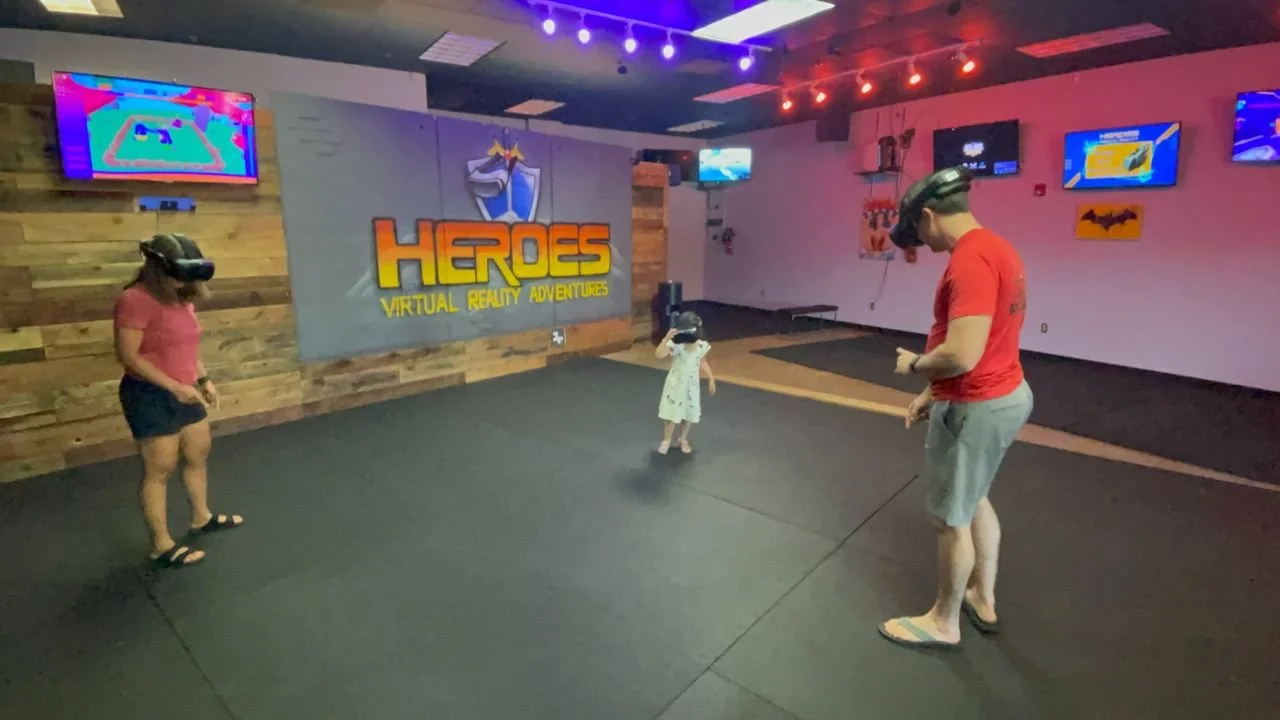
Younger kids get their own genuine VR experience in our Junior HEROES adventures. Junior HEROES uses no handheld controllers at all. The experience responds to head movement and physical presence, which means a four-year-old can navigate it as naturally as they'd walk around a room.
We require at least one adult to participate in Junior HEROES sessions not just because it's a genuinely great shared experience, but because having a parent or guardian present helps younger kids stay grounded, reframe what they're seeing if anything feels confusing, and get the most out of the experience.
It's also, frankly, one of the most unexpectedly enjoyable experiences for families. Many parents end up having just as much fun as their kids.
Under 4:
We don't recommend VR for this age group. The equipment isn't designed to fit very small heads, and the format doesn't lend itself meaningfully to that developmental stage.
What the Research Actually Says
Brief, supervised VR use in children is generally well tolerated, and the evidence doesn't support the idea that occasional VR causes any lasting harm.
The American Academy of Ophthalmology, in guidance cited by the American Academy of Pediatrics, states there's no reason to be concerned that VR headsets damage eye development, health, or function. Although long-term data are still accumulating.
Most studies point to temporary effects like eye fatigue, mild dizziness, or brief disorientation that usually goes away quickly after removing the headset.
Short, supervised, occasional VR sessions with age-appropriate content and engaged adults nearby fit well with current research suggesting that it is a low-risk activity for most children.
That's a very different picture from what some alarmist headlines might suggest and it's consistent with what we've observed at HEROES over thousands of visits with young guests.
What About Motion Sickness?
This one is worth addressing directly because it's the most common short-term concern the research flags. The good news is that meaningful nausea is uncommon. Fewer than 2% of HEROES guests experience it.
Most people, including most kids, have no issues at all. But some people are more sensitive to the vestibular mismatch that VR can produce and it's worth knowing what to do if it happens.
If you or your child starts feeling off, feel any nausea, dizziness, or general "not right" sensation, stop immediately. Take the headset off, sit down, drink some water, and give it a few minutes. Don't push through; that reliably makes it worse. Once you're feeling better, you can head back in. It also often helps to switch to a different experience, since games vary widely in how much they trigger motion sensitivity. Our guides are good at helping find the right fit.
We've also written a full post on VR motion sickness, what causes it, who's more prone to it, and how to minimize the chances of it happening. It’s worth a read before your visit if you or your child has any history of motion sensitivity.
A Note on Physical Safety
Home VR has a well-documented hazard that commercial venues largely eliminate: the living room. The VR fail videos you've seen almost always involve someone backing into a coffee table, tripping over a dog, catching a controller on a lamp, or sending that same controller into the TV.
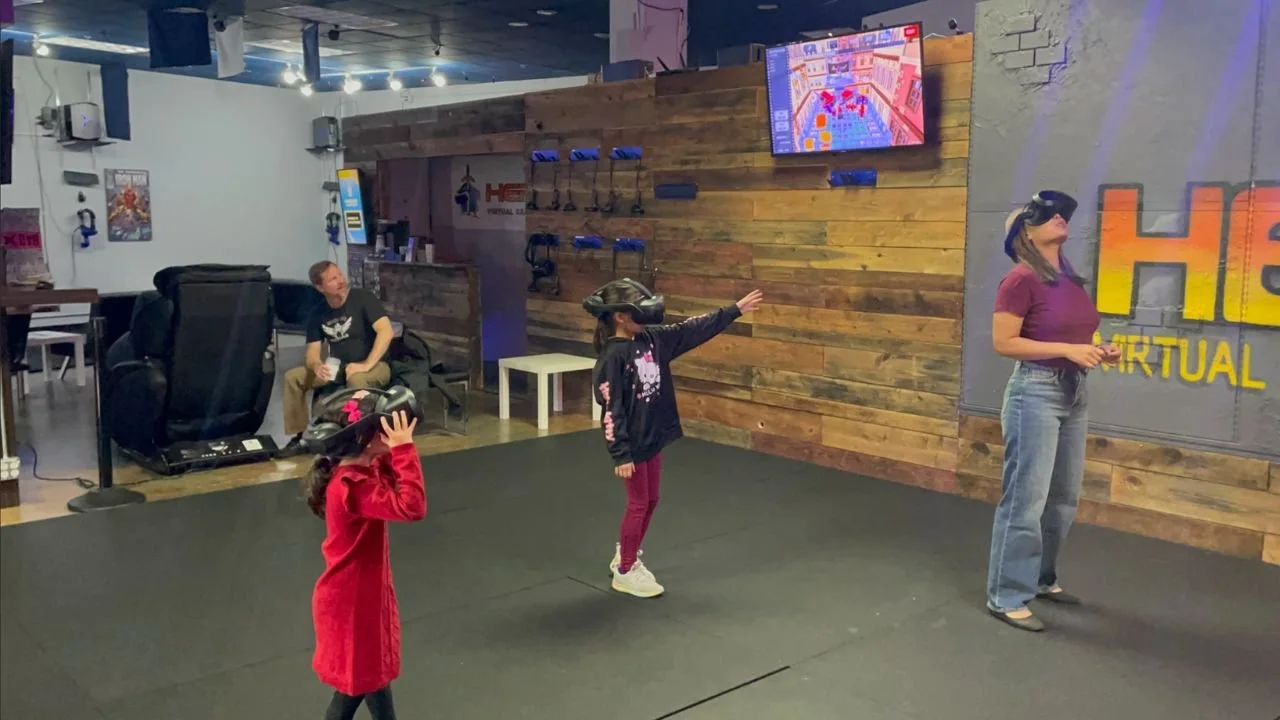
At HEROES VR, every play space is a purpose-built, open, padded area with no furniture, no cords to trip over, and no glass surfaces within swinging distance. The Free Roam arena is designed specifically for multi-person movement.
Our guides monitor play areas and intervene if anyone wanders toward a boundary. The physical safety profile of a supervised VR venue is genuinely different and better than home use, almost by definition.
How We Keep It Safe in Practice
A few things HEROES does operationally that align with what the evidence suggests for responsible VR with kids:
Content controls: All content is visible to spectators on monitors outside the headsets for parents to see exactly what their kids are experiencing. We also have content filters to limit access to more intense experiences for younger or more sensitive guests. Nothing is hidden, and the guides are active in helping everyone find the right fit.
Staff involvement: Our guides don't just hand you a headset and walk away. They orient every guest, check in during sessions, and are genuinely attentive to whether anyone seems uncomfortable. If something isn't working, they'll help find something that does.
Breaks are always available: If you or your child feels any eye strain, fatigue, or dizziness at any point, just take a break. Step out of the headset, sit on the couches, grab some water. There's no pressure to keep playing. The session time is yours so, use it the way that feels right for your group.
Parental involvement: For Junior HEROES specifically, having a parent in the experience with the child isn't just encouraged, it's part of the format. The experience is designed for it, and the results are consistently better when parents participate rather than spectate.
One of the things HEROES is most proud of is how well VR works as a shared experience across generations. Parents who plan to sit on the couch and watch their kids play are always rewarded when they end up putting on a headset themselves and jump in. Grandparents who came along to be supportive end up being the ones who don't want to stop. VR makes it easy for family members of different ages to play together and share the same experience.
That's not an accident. That's the whole point. VR at HEROES is built around bringing people together, not putting one person in a headset while everyone else watches. The more of your group that plays, the better the experience gets.
The Bottom Line
At the end of the day, you know your child best. What the research supports, and what we've seen at HEROES across thousands of young visitors, is that occasional, supervised VR in a purpose-built venue is a low-risk, high-reward experience for most kids. The concerns that exist are real but manageable.
For most kids, occasional and supervised VR can be a fun and low-risk experience. Like any activity, it works best when parents stay involved and pay attention to how their child responds.
That's the approach we take at HEROES, and it's the approach we'd encourage any parent to bring to the visit. If you're curious about whether VR is a good fit for your child, the best way to learn is to experience it together.
FAQs
Q1: What age is appropriate for VR at HEROES VR Adventures?
Most standard experiences suit kids aged eight and up comfortably. Staff can advise on the best game choices.
Q2: Is VR safe for children’s eyes and development?
Short, supervised sessions show no lasting eye development harm. Long-term studies are still ongoing but reassuring so far.
Q3: How does HEROES keep VR physically safe for kids?
Play areas are padded, open, and free from furniture hazards. Guides also watch play zones and step in when needed.
Q4: Can parents see what their child views in VR?
Yes. Spectators view content on outside monitors in real time. This helps parents decide if the content fits their child.
Q5: Do HEROES experiences encourage physical movement?
Yes. VR at HEROES involves ducking, turning, and active movement. Movement helps make the experience engaging and physically active.
