
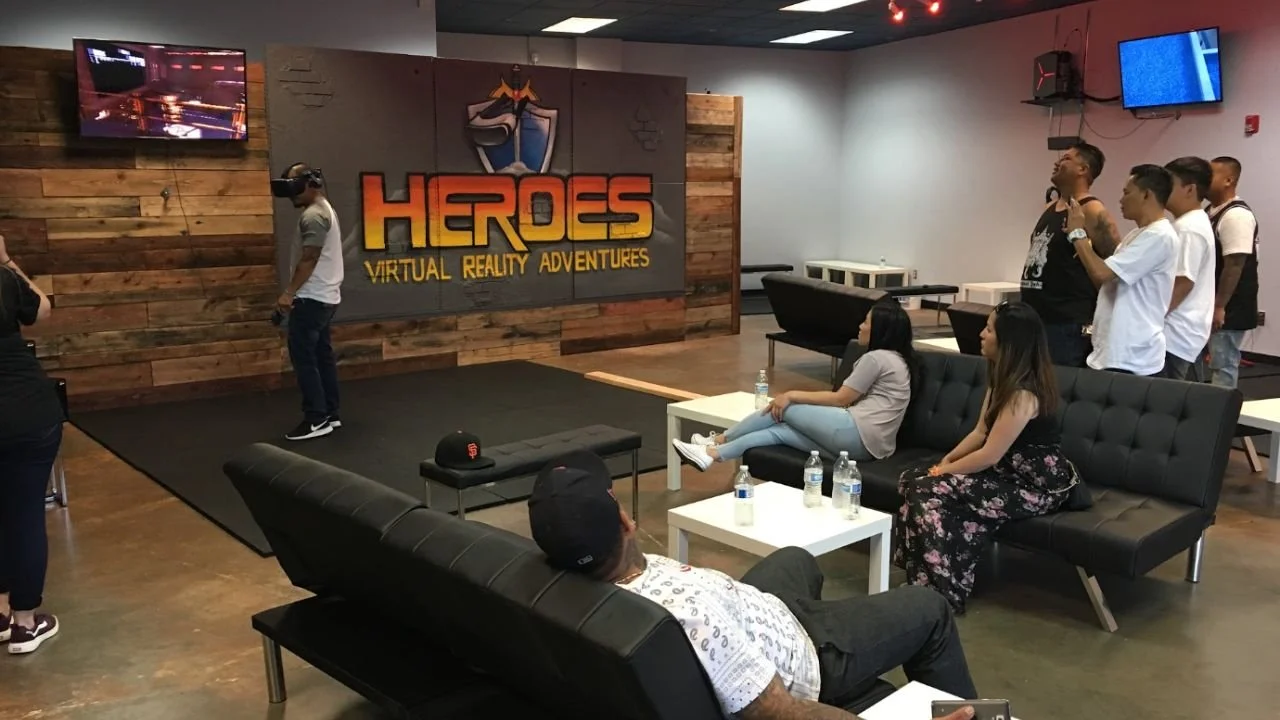
You’ve got a group together, everyone’s agreed on VR, and then the booking page gives you another decision: Free Roam or Room Scale.
If you haven’t tried either, those labels don’t tell you much. One sounds like you can walk wherever you want. The other sounds like you’re standing in a room. But neither quite explains what the visit will feel like, whether your friends can play together, or which option makes sense for someone who’s never worn a headset.
The difference comes down to how you use the physical space. At HEROES VR Adventures in Roseville, you can choose either. Here’s what you’re actually choosing between.
The Space Changes the VR Experience
Imagine putting on a headset and finding your friends beside you inside the game. You turn toward someone, step into position, and start working through whatever the experience throws at your group. You’re sharing the virtual environment and the physical floor underneath it.
That’s the idea behind Free Roam VR.
Now imagine stepping into your own play area. You can reach, turn, duck, and move within its boundaries, while the game opens up a world much larger than the space around you. Your friends might be playing alongside you through connected stations, or trying something completely different.
That’s Room Scale.
In short, Free Roam VR puts your group inside a shared arena, moving through an experience together. On the other hand, Room Scale VR gives each player an individual movement area, with games that can still connect everyone inside the same virtual world.
Both can be social and active. The useful distinction is whether your group wants to move around one arena together or enjoy the flexibility of separate stations.
What Free Roam Actually Feels Like
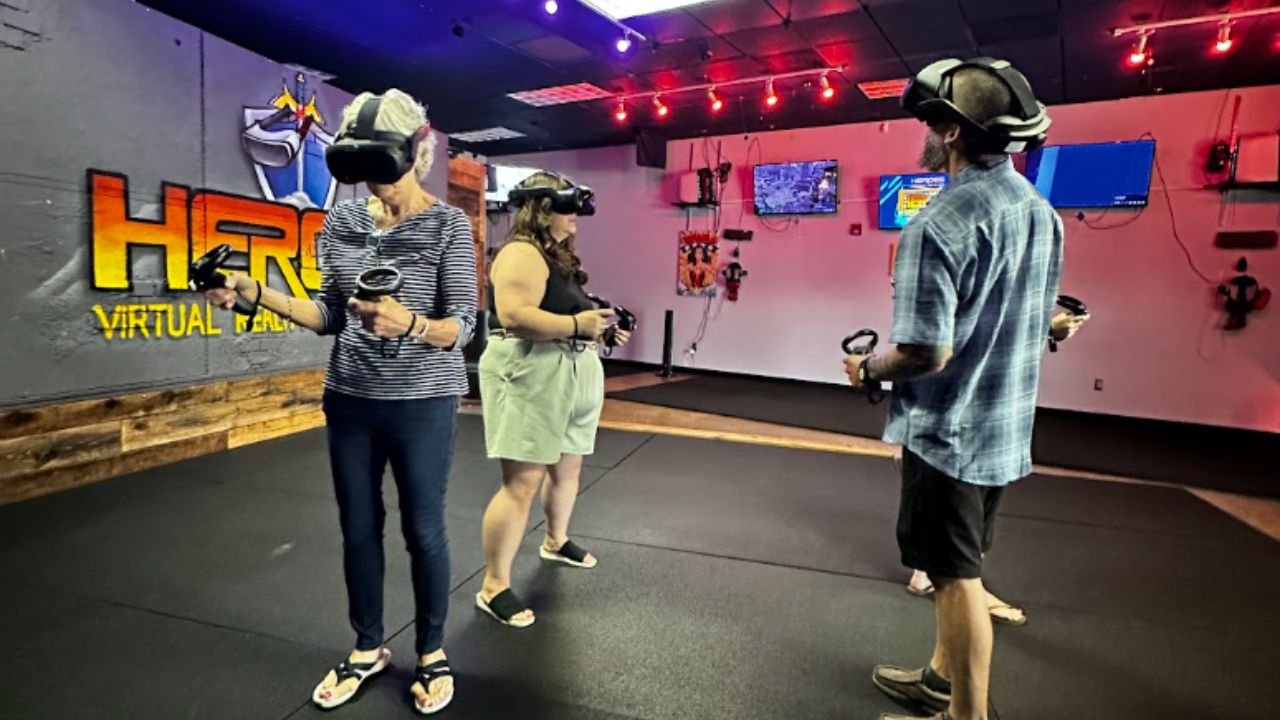
The appeal of Free Roam becomes clearer once you stop thinking about the headset and start thinking about the people around you.
Your teammate is somewhere to your left. Someone behind you needs help. You turn, reposition, and respond together. Depending on the game, where everyone stands and how they coordinate can become part of the challenge. HEROES’ wireless Free Roam arena accommodates up to six players together. There’s no need to occupy separate bays, and physically walking around the designated space is part of the experience.
For a group that arrives wanting one shared adventure, that arrangement makes immediate sense. Everyone has the same thing to react to, the same objective to work toward, and usually a few different opinions about what happened afterward.
Freedom still has limits. You’re playing inside a mapped arena, following the movement instructions provided by staff. “Free Roam” describes movement within that space, rather than permission to run wherever the game makes you feel like going.
What Room Scale Actually Feels Like
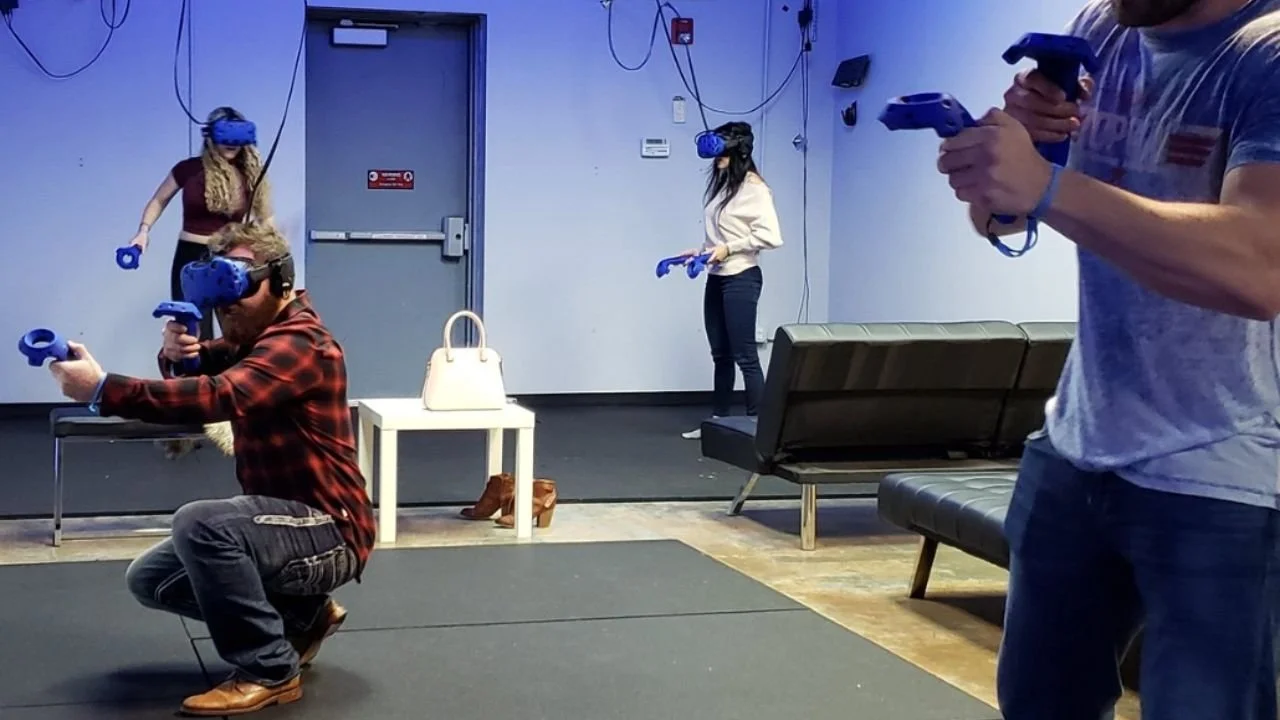
Room Scale sometimes gets mistaken for the less immersive option, mostly because “individual station” sounds less exciting than “shared arena.” That misses what makes the format work.
Your play area gives you space to move while the game determines what you’re doing. You might be aiming a bow, reaching for a puzzle piece, keeping time with a rhythm game, or exploring an unfamiliar environment. Movement beyond the physical bay depends on the controls and design of the particular title.
The variety is a big part of the appeal. At HEROES, Room Scale offers a broad library and the ability to switch between available games during your session. That matters when your group doesn’t arrive with identical interests.
One person wants action while another would rather solve something. Someone else discovers that the game they were most excited about isn’t their thing after all. With individual stations, the visit has room for those differences.
Separate Stations Don’t Mean Playing Alone
This is probably the biggest misunderstanding in the comparison. Room Scale VR can support multiplayer experiences. Your group occupies separate physical areas, but compatible games bring you together virtually.
You can coordinate, compete, and work toward shared objectives without standing on the same arena floor. The game’s player limit determines how many people can join, so it’s worth checking the title rather than assuming every multiplayer experience accommodates your whole group.
For friends who want to play together, that opens up another question: does physically sharing the space matter to you? Sometimes it does. Walking alongside your friends is exactly what makes the outing interesting. Other times, everyone mainly wants a good cooperative game, and separate stations work perfectly well.
The Variety Factor
A group booking often starts with one enthusiastic person and several people willing to give it a try. The enthusiast has already watched gameplay videos. Their partner wants something approachable. A friend says they’ll play anything, then immediately rules out horror. Someone’s parent hasn’t touched a controller in years. This is where having options makes a difference.
Room Scale gives that group a way to explore different interests without needing everyone to commit to the same type of experience. They can find a multiplayer title together, try individual games, or ask staff for another recommendation when something isn’t landing.
Free Roam makes a different proposition: choose an arena experience your group wants to share, then step into it together. Neither arrangement guarantees a better afternoon. One suits a group that wants choices throughout the visit. The other suits a group whose main priority is doing the same thing together.
Does Free Roam Mean Full Body VR?
This is another place where the terminology gets a little loose. People sometimes use full body VR to describe an experience that gets them physically involved. They’re walking, turning, ducking, and reaching, so the phrase feels appropriate.
Full-body tracking has a more specific technical meaning. It concerns how a system captures body movement, potentially using additional trackers or other tracking methods beyond the headset and controllers.
A wireless headset and room to walk don’t automatically mean every part of your body is being tracked independently. For most visitors, the more useful question is what they’ll actually do during the game. If you specifically want tracked feet, legs, or hips, ask about that feature directly. If you mainly want an active adventure with your friends, focus on the gameplay and movement requirements.
Which One Fits Your Group?
Start with the people coming, rather than the format that sounds more advanced.
Free Roam VR is worth considering when everyone wants a shared arena adventure and is comfortable moving around the same space. It’s particularly appealing when walking together is part of what you’re excited to try.
Room Scale works when you want variety, interests differ, or some players want their own movement area. It also gives solo visitors a straightforward way to explore available experiences.
Before booking, settle a few practical details:
Check the youngest player’s eligibility: Age recommendations vary by format and game.
Confirm simultaneous player numbers: Venue capacity and individual game limits are different things.
Ask what your reservation includes: Make sure you understand the format, available games, and scheduled time.
Mention movement or comfort needs: Staff can explain what particular experiences involve.
Choosing Your Experience at HEROES
HEROES VR Adventures offers both formats in Roseville, with staff available to help guests get comfortable and choose suitable experiences. That’s useful because you don’t need to arrive knowing your group’s perfect game. You need a reasonable sense of what everyone enjoys, who’s trying VR for the first time, and whether the priority is variety or a shared arena adventure.
You can choose Free Roam when moving together is the attraction. Choose Room Scale when you want room to explore different kinds of play. Then let the game give everyone something to talk about on the way home. Explore the available experiences at HEROES VR Adventures and choose the format that fits your crew.
FAQs
Q1: Can we play together in Room Scale VR?
Yes. Compatible multiplayer games connect players across individual stations. Your group shares the virtual experience while everyone keeps their own physical play area.
Q2: Is Free Roam suitable for first-time players?
It can be. The important details are the chosen game, its age requirements, and everyone’s comfort with the movement involved. Let staff know who’s new before selecting an experience.
Q3: Do you move around in both formats?
Yes. Room Scale allows movement within an individual play area. Free Roam centres the experience around movement through a shared arena.
Q4: Does Free Roam include full-body tracking?
The format alone doesn’t establish which body parts are tracked. Ask about the specific equipment and game if full-body tracking is a feature you want.
Q5: Which format should we choose for a birthday?
Start with the birthday guest’s interests, then consider ages and group size. A shared arena adventure may be the draw, while individual stations can suit guests with different game preferences.
